
There’s a quiet migration happening in the side hustle world, and almost nobody is talking about it directly. People aren’t abandoning side income. They’re abandoning the kinds of side income that an algorithm can replicate in four seconds.
Here’s the strange part. The hustles getting wiped out by AI weren’t the “easy” ones. They were the ones that felt skilled: writing generic blog posts, basic logo design, simple data entry, templated social captions. Meanwhile, the hustles surviving (and in some cases thriving) are often things that sound almost too simple to be valuable.
That’s not a coincidence. It’s a pattern economists call “Moravec’s Paradox,” and once you understand it, you’ll never look at side income the same way again.
The Paradox Hiding Inside Every “Future-Proof” Job List
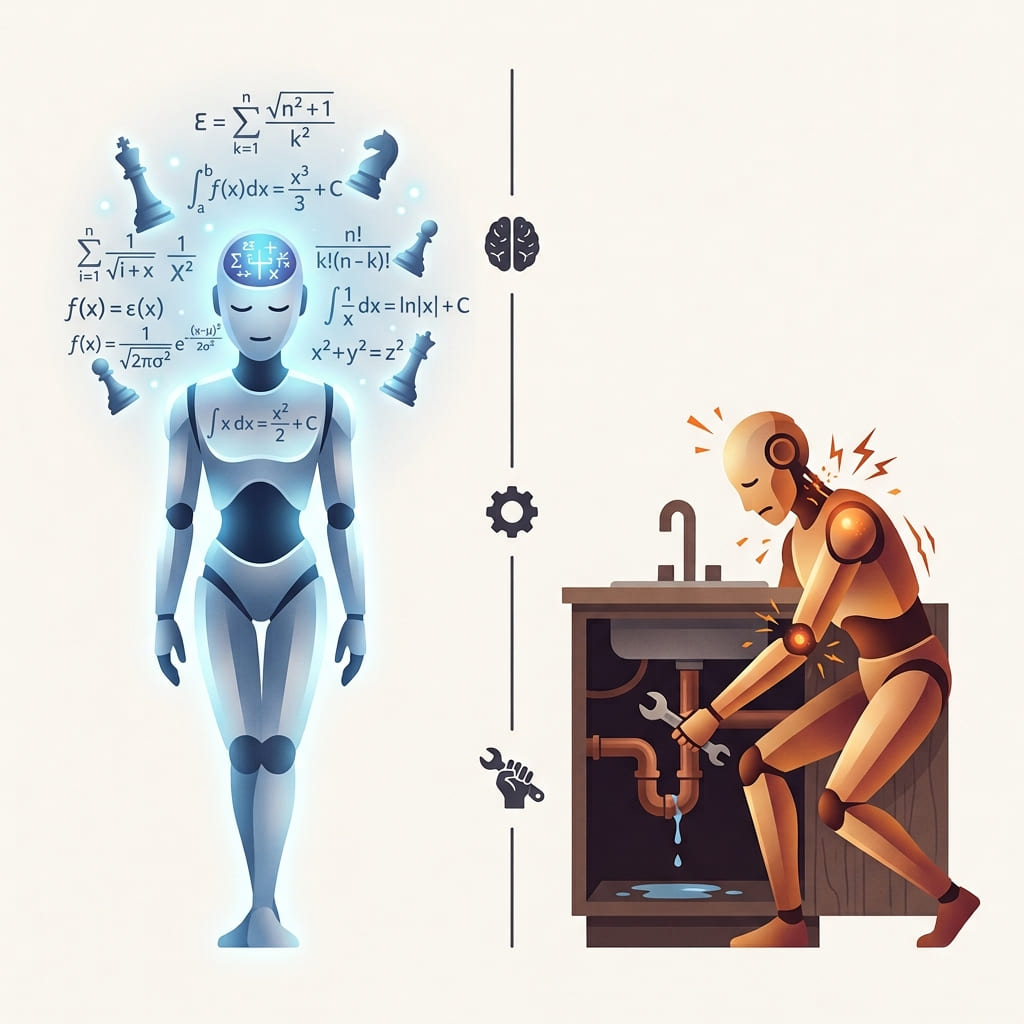
Moravec’s Paradox, named after AI researcher Hans Moravec, observes something counterintuitive: tasks that are hard for humans (advanced math, chess, writing competent prose) turned out to be relatively easy for machines. But tasks that are trivially easy for humans (folding laundry, noticing a client is annoyed, fixing a leaky faucet, building trust with a stranger) remain brutally hard for machines.
Most “future of work” articles get this backwards. They tell you to compete on intelligence. The smarter move, and the one quietly being adopted by people earning real money right now, is to compete on the things AI is structurally bad at: physical presence, embodied trust, local context, and liability.
That single insight explains almost every hustle on this list.
1. Skilled In-Person Trades (The Forgotten Goldmine)
Plumbing, appliance repair, HVAC diagnostics, and electrical work are seeing a quiet renaissance among side hustlers, partly because trade school enrollment dropped for over a decade while demand didn’t. An AI model can write you a flawless explanation of how to fix a garbage disposal. It cannot crawl under your sink and do it.
Here’s the part most people miss: the bottleneck isn’t skill, it’s licensing and trust signals. A handyman with verified reviews and basic certifications can often out-earn someone with a master’s degree, simply because supply is so constrained.
This same supply-constraint logic is exactly what’s explored in 7 Things You’re Already Sitting On That Pay You Money While You Sleep. The asset classes people are renting out right now would have sounded like science fiction five years ago, and the reason they work is structurally identical to why the plumber gets paid more than the analyst.
2. Peer-to-Peer Asset Rental (Turo, Neighbor, and the “Idle Asset” Effect)
Most people think of side income as time for money. The smarter version is idle assets for money. Your car sits parked 23 hours a day. Your garage sits empty. Your driveway, your power tools, your camping gear.
Platforms like Turo (https://turo.com) let you rent out a car the way Airbnb lets you rent a spare room. Neighbor (https://www.neighbor.com) does the same thing for storage and parking space. The behavioral finance insight here is subtle but important: people dramatically underestimate the value of assets they already own because ownership creates an “endowment blindness,” we stop seeing what we have as a resource the moment we stop actively using it.

But here’s the part that catches almost everyone off guard. The most profitable rental categories right now aren’t the obvious ones like cars and rooms. They’re niche, oddly specific items with almost no competition. We go deep on exactly which categories are quietly printing money in How People Are Getting Rich Renting Things That Don’t Exist Yet, and a few of them will genuinely surprise you.
3. High-Trust Freelance Services (Where AI Still Can’t Compete)
Freelance writing got hammered by AI. Freelance bookkeeping, contract review summaries for non-lawyers, and fractional operations support did not, because clients aren’t paying for words on a page. They’re paying for someone who will be accountable if something goes wrong.
Platforms like Upwork (https://www.upwork.com) and Fiverr (https://www.fiverr.com) have seen a measurable shift in what actually books clients: not “I can write content” but “I can take this messy, liability-bearing problem off your plate and put my name on the result.”
That liability piece is the whole game, and it connects to something genuinely strange: people with nearly identical resumes can earn wildly different amounts doing the same freelance work, for reasons that have nothing to do with skill. There’s a deeper explanation for that gap, and it’s one of the stranger threads we pull on in 13 Strange Websites Paying People for Skills They Didn’t Know Were Worth Money.
4. Pet and Elder Care On-Demand
This one sounds almost too humble to mention, yet it’s quietly one of the most recession-resistant and AI-resistant hustles available. Dog boarding, drop-in pet visits, and non-medical elder companionship all require something AI cannot fake: physical presence paired with earned trust. Nobody hands their dog, or their aging parent, to an algorithm.
The pricing power here surprises people. Demand consistently outpaces supply in most mid-sized cities, which means experienced sitters with good reviews can charge premium rates that rival entry-level professional salaries, just by being reliable and showing up.
5. Micro-Consulting in a Narrow Expertise
Not “business consulting.” Something absurdly specific: helping someone optimize a single spreadsheet, helping a small landlord understand a lease clause, helping a new parent pick a stroller based on actual durability data rather than marketing. The narrower the expertise, the harder it is for a generic AI answer to compete, because the value isn’t information, it’s judgment applied to one person’s exact situation.
This is the same hidden mechanism behind something most people never connect to side income at all: the websites paying ordinary people for knowledge they didn’t realize was monetizable. We unpack a list of these in 13 Strange Websites Paying People for Skills They Didn’t Know Were Worth Money, and a few of the categories are genuinely unexpected.
6. Local Event and Photography Services
AI image generators have gotten startlingly good at producing photorealistic stock-style images. What they still cannot do is show up. They cannot read a room, anticipate the exact second a grandmother tears up watching her granddaughter’s first dance, or notice that the best man is about to knock over the cake. That’s not a technical limitation that’s getting solved next year. It’s a structural one: AI has no body and no presence in time.
This is why event-based photography and videography have held their pricing power even as generic stock photography work has collapsed. Wedding photographers, in particular, benefit from something behavioral economists call “irreplaceability premium”: a couple isn’t paying for 500 technically competent photos, they’re paying for the one or two images that capture an irreplaceable moment, and they know it can never be reshot. That emotional stakes structure is what keeps prices high even in a market flooded with cheap cameras and editing apps.
The practical entry point most people miss: you don’t need to start with weddings. Local businesses constantly need event coverage (grand openings, fundraisers, youth sports tournaments) and pay reliably, with far less competition than the wedding market.
7. Specialized Repair and Restoration
Here’s a number that surprises most people: the average age of a furniture restorer, watch repairer, or instrument technician in the US has been climbing for years, because almost nobody under 40 is entering these trades. Meanwhile, demand for repair over replacement has been rising, partly driven by sustainability concerns and partly by the simple fact that older, well-built items are often higher quality than their modern mass-produced replacements.
This creates a specific kind of opportunity: a widening generational supply gap. Someone who learns upholstery repair, vintage radio restoration, or violin setup today isn’t entering a crowded market, they’re entering one where the existing experts are retiring faster than new ones are showing up. AI cannot rebuild a 1962 amplifier or re-glue a chair joint, because the work requires physical dexterity, material judgment, and tacit knowledge that was never written down in a way a model could learn from.

The financial upside here compounds quietly. Restoration specialists often command higher hourly rates than general handyman work, precisely because so few people can do it, and referrals tend to flow through tight-knit hobbyist communities (antique collectors, musicians, watch enthusiasts) who pay well and pay reliably once they trust you.
8. Voice and Audio Work for Niche Markets
AI voice synthesis has crossed an uncomfortable threshold: for generic narration, it’s often good enough. This has genuinely shrunk the market for bland, neutral-accent voiceover work. But it has simultaneously made specificity more valuable, not less.
Here’s the mechanism. AI voice models are trained on massive datasets that skew toward “standard” accents and “standard” emotional registers, because that’s what’s abundant in training data. What remains scarce, and therefore valuable, is texture that doesn’t generalize well: a specific regional dialect, genuinely funny comedic timing, the particular warmth needed for a children’s audiobook, or culturally specific delivery for a local-language ad campaign.
Voice actors who’ve adapted successfully aren’t competing on “can I read a script clearly.” They’re competing on “can I deliver something an AI model would need thousands of hours of specialized training data to even approximate.” Audiobook narration in underserved languages, character voice work for indie games, and hyper-local radio ads are three categories where human voice work has actually seen demand increase, not decrease, since AI voice tools became mainstream.
9. Reselling and Sourcing (The Arbitrage Nobody Talks About)
This is one of the oldest profit mechanisms in finance, arbitrage, wearing a thrift-store disguise. Arbitrage means buying something undervalued in one market and selling it in a market that values it correctly. Thrift flippers, estate sale sourcers, and retail arbitrage sellers are doing exactly what hedge fund analysts do, just with vintage Levi’s instead of mispriced bonds.
The reason this remains AI-resistant is almost entirely physical. An AI model can tell you that a certain brand of vintage Pyrex sells for a premium online. It cannot walk into an estate sale, pick up a chipped bowl, judge by touch and sightline whether the chip is disqualifying or charmingly “patina,” and make a split-second buy decision before someone else grabs it. That judgment, built from repetition and pattern recognition under real-world conditions, is exactly the kind of “easy for humans, hard for machines” task Moravec’s Paradox predicts.
There’s also a quieter financial lesson buried in here: people who succeed at reselling long-term tend to specialize ruthlessly (only vintage cameras, only mid-century furniture, only designer denim) rather than going broad. Specialization lets them build pricing intuition far faster than generalists, which is the same reason concentrated expertise beats diversified mediocrity in plenty of other markets too.
10. Tutoring With a Twist
Generic tutoring, the kind where you simply explain a concept clearly, is under real pressure, because AI chatbots are available 24/7, infinitely patient, and free or nearly free. A student struggling with a algebra concept at 11pm now has options that didn’t exist five years ago.
What’s thriving instead is outcome-anchored tutoring: SAT and ACT prep with a target score, coding bootcamp support tied to a job placement, language tutoring tied to a specific visa or job interview deadline. The behavioral finance principle at play here is one investors know well: people consistently pay a premium for certainty and outcomes over information alone, even when the underlying information is freely available elsewhere. A free textbook chapter on calculus and a $90/hour tutor explaining the same material aren’t really competing products, because the tutor is selling accountability, pacing, and a deadline-driven outcome, not just facts.
The data backs this up: tutors who can point to specific score improvements or job placements consistently out-earn tutors who market themselves on subject knowledge alone, sometimes by two or three times the hourly rate.
11. Building Small Digital Assets Once, Earning From Them Repeatedly
This is the highest-leverage hustle on the list, and also the most misunderstood. People hear “build it once, earn forever” and assume it requires either a huge existing audience or a stroke of luck. Neither is actually true.
The real mechanism is closer to compounding interest than to a lottery ticket. A small, useful digital asset, a niche template, a tiny browser tool that solves one annoying problem, a paid newsletter serving an oddly specific audience, earns a small amount repeatedly instead of a larger amount once. Multiply that by several small assets over a couple of years, and the repeated small payments start to resemble a modest dividend portfolio more than a side hustle.

The mistake almost everyone makes is building for a broad audience first. Counterintuitively, the assets that earn most reliably tend to serve audiences so narrow they initially feel too small to bother with, because narrow audiences have less competition and clearer, more specific willingness to pay. That exact mechanism, why “too niche” is often the safest place to start rather than the riskiest, is the entire foundation of I Built These 11 Digital Assets Once, They Still Pay Me Every Month.
The Real Takeaway
Every hustle on this list shares the same underlying logic: AI is excellent at producing information and mediocre at producing trust, presence, and accountability. The side hustles quietly winning right now aren’t the flashy ones. They’re the ones built on something a model still can’t fake.
If there’s one mental model worth keeping from this entire article, it’s this: stop asking “what can AI do?” and start asking “what does AI make more valuable by not being able to do it?” That second question is where the real opportunity is hiding.