Have you ever paid for something you never actually owned?
Most people have.
Spotify subscribers pay for music they never possess. Netflix users pay for movies they never store. Businesses pay monthly for software that never arrives in a box.
And yet many people still think wealth comes primarily from owning physical things.
That assumption is becoming increasingly expensive.
The modern economy is quietly rewarding people who create, control, or rent access to assets that exist only as information.
The surprising part is that many of these assets can be built once and rented thousands of times.
Some of the smartest entrepreneurs today are not buying apartment buildings.
They’re building digital properties.
And many people haven’t noticed the shift.
The Great Transition From Ownership to Access
For most of history, wealth was closely tied to physical scarcity.
If you owned farmland, factories, machinery, or rental property, you possessed something others needed.
Your ownership created leverage.
Today, something strange is happening.
Increasingly, consumers care less about ownership and more about access.
Think about it.
Millions of people rent movies instead of buying DVDs.
Businesses rent cloud servers instead of owning data centers.
Designers rent software subscriptions instead of purchasing permanent licenses.
The economic value hasn’t disappeared.
It has simply migrated.
And where value migrates, opportunities follow.
This creates a fascinating question:
What happens when the thing being rented isn’t physical at all?
The answer explains why some individuals are quietly earning recurring income from products that exist only as code, information, or digital infrastructure.
The Hidden Power of Non-Rival Assets
Economists use a term called “non-rival assets.”
A rival asset can only be used by one person at a time.
Your car is rival.
Your house is rival.
A hotel room is rival.
But a digital template?
A piece of software?
An online database?
A digital design?
Those can often be used simultaneously by thousands of people.
This changes the economics completely.
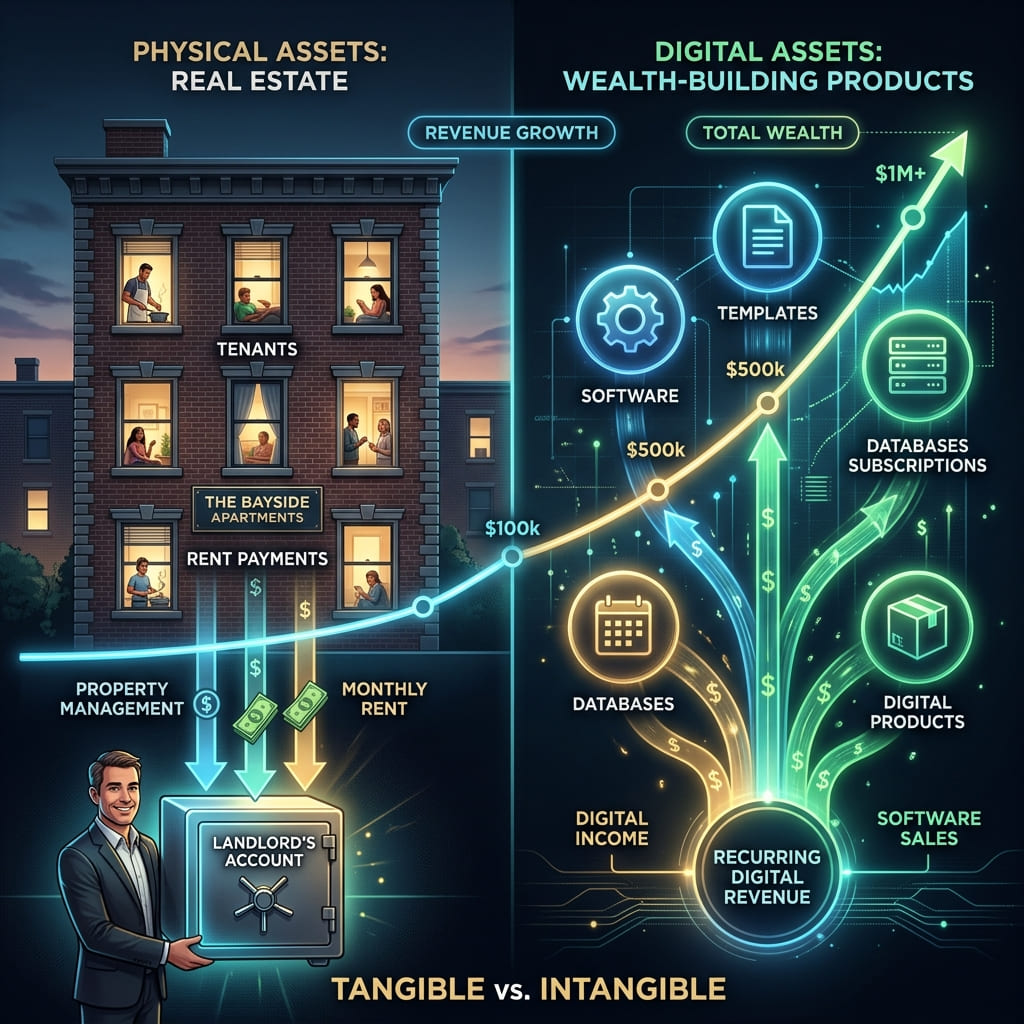
A landlord renting a physical apartment must constantly deal with maintenance, repairs, vacancies, taxes, and tenant turnover.
A creator renting access to a digital asset can potentially serve ten users or ten thousand users with minimal additional cost.
The real advantage isn’t what most people think.
Most people focus on scalability.
The deeper advantage is that digital assets often become more valuable as more people use them.
Physical assets wear out.
Many digital assets become stronger.
That distinction matters enormously.
The Asset Class Most People Don’t Realize Exists
Imagine someone creates a collection of spreadsheet tools for small business owners.
Nothing revolutionary.
Just useful.
They upload them to an online marketplace.
The first sale earns a few dollars.
Then another.
Then another.
Months later, customers are still purchasing the same product.
Years later, some may still be generating revenue.
What’s fascinating is that the creator isn’t really selling a spreadsheet.
They’re renting a solution to a recurring problem.
This subtle distinction changes how wealthy people think about income.
Instead of asking:
“How can I sell more products?”
They ask:
“How can I build an asset that solves the same problem repeatedly?”
That mental shift often separates workers from asset builders.
And asset builders tend to benefit disproportionately from technological change.
Interestingly, this connects to a pattern we uncovered in “11 Digital Assets You Can Build Once and Get Paid From for Years.”
Many people assume recurring income requires constant effort.
The evidence suggests something very different. Certain digital assets become more productive over time, even when their creators are working on something else entirely. The mechanism behind that phenomenon is surprisingly overlooked.
Why Intelligent People Miss This Opportunity
Here’s the paradox.
The opportunity is visible.
Yet many smart people ignore it.
Why?
Because human psychology evolved around physical objects.
We instinctively assign value to things we can touch.
A rental property feels real.
A piece of software feels abstract.
A warehouse feels substantial.
A database feels invisible.
Behavioral economists call this a salience bias.
People naturally pay more attention to what they can easily see.
Unfortunately, wealth doesn’t always follow visibility.
Some of the most valuable companies in history built fortunes from invisible infrastructure.
Consumers rarely think about payment processors, cloud computing systems, search algorithms, or digital networks.
Yet these systems quietly collect revenue every day.
This creates a hidden effect few investors notice.
The less visible an opportunity becomes, the fewer competitors often pursue it.
And lower competition frequently leads to higher returns.
Real-World Examples of Renting the Invisible
Consider website themes.
A designer creates a premium theme once.
Thousands of customers pay for access over time.
The product remains digital.
The income remains real.
Or consider data subscriptions.
Businesses routinely pay monthly for information that helps them make better decisions.
The information itself is intangible.
Its economic value is not.
Another fascinating example involves digital communities.
Some operators build niche communities around highly specific expertise.
Members pay recurring fees for access to discussions, insights, resources, and networking opportunities.
Nothing physical changes hands.
Yet significant value is exchanged.
But that’s not the most interesting example.
Increasingly, entrepreneurs are renting AI-powered tools, automation systems, and specialized workflows.
Many users don’t want ownership.
They simply want results.
And results are often easier to rent than to build.

This trend connects to another unusual discovery explored in “13 Strange Websites That Pay Ordinary People for Skills They Didn’t Know Were Valuable.”
Many profitable opportunities emerge not because people possess rare skills, but because they package ordinary skills into systems that others can repeatedly access. Most people completely miss the next step. That next step is where the economics become surprisingly powerful.
When Recessions Can Actually Help
Most people assume economic downturns destroy opportunities.
Sometimes they do.
But certain invisible assets behave differently.
During uncertain times, businesses become obsessed with efficiency.
They look for ways to reduce labor costs.
They seek better data.
They automate repetitive tasks.
They search for tools that save time.
Notice the pattern.
These needs often increase demand for digital solutions.
A company may cancel office expansion plans during a slowdown.
It may still invest in software that saves hundreds of employee hours.
This creates an investing lesson worth remembering:
People don’t stop spending during difficult times.
They become more selective about what problems they are willing to pay to solve.
The entrepreneurs who understand this distinction often outperform expectations.
There’s another hidden layer to this story.
We explored it while researching “7 Secret Side Hustles That Benefit From Economic Downturns Instead of Suffering From Them.”
At first glance, recession-resistant income streams seem unrelated to digital assets. But both are driven by the same underlying force: when uncertainty rises, demand shifts toward solutions that reduce risk, save money, or increase efficiency. Once you recognize that pattern, you start seeing opportunities in places most people overlook.
The Toll Bridge Mental Model
One of the most useful wealth-building mental models is the toll bridge.
Imagine two businesses.
Business A sells products one transaction at a time.
Business B owns the bridge everyone must cross.
Which would you rather own?
Most investors instinctively choose the bridge.
The bridge captures value repeatedly.
Digital assets often function exactly this way.
A useful database becomes a bridge.
A software tool becomes a bridge.
A specialized platform becomes a bridge.
A marketplace becomes a bridge.
Every time someone crosses, value flows back to the owner.
The surprising consequence appears years later.
Many successful digital asset creators didn’t become wealthy because they created something extraordinary.
They became wealthy because they created something useful that sat between demand and a desired outcome.
The distinction is subtle but important.
Extraordinary products are difficult to build.
Useful bridges are often easier.
The Mistake That Keeps Most People Stuck
Most people focus on income.
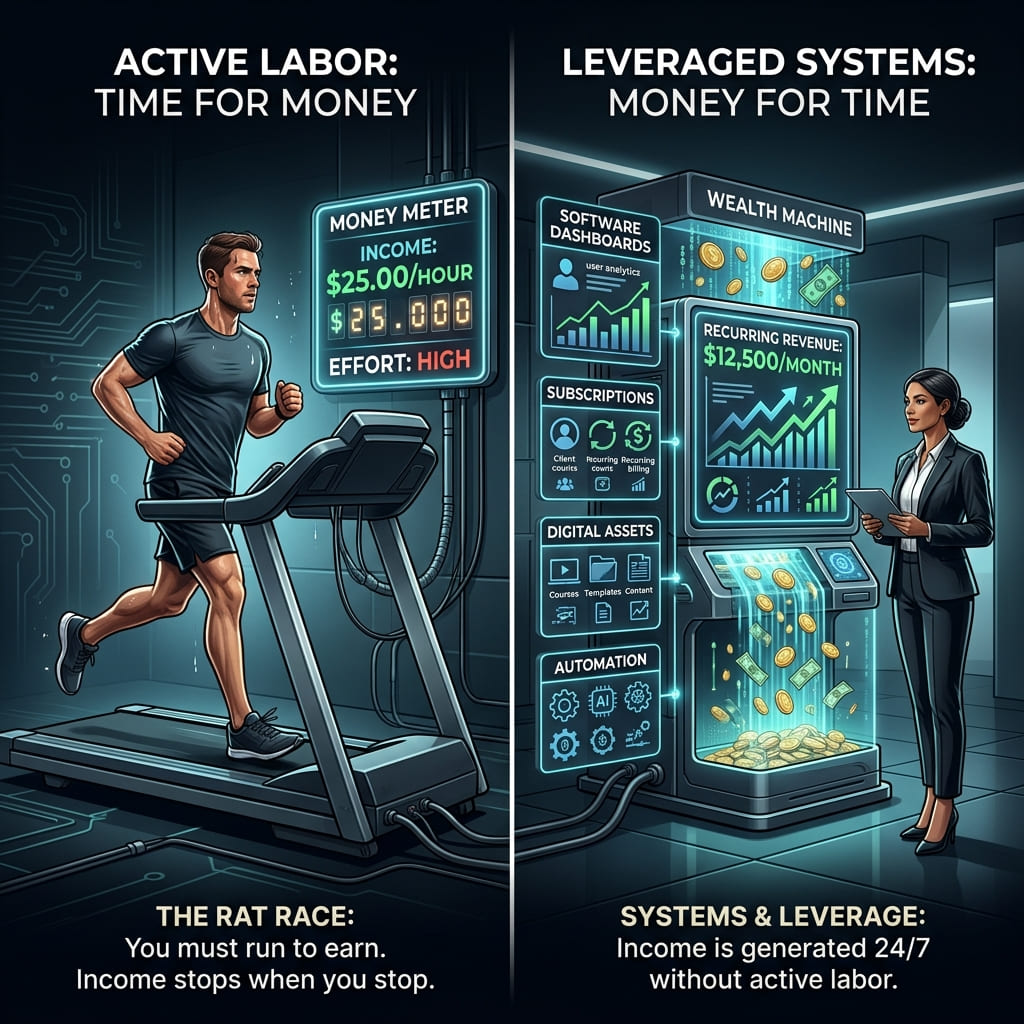
Wealthy people often focus on systems.
Income answers:
“How much can I earn today?”
Systems answer:
“How many times can this work without me?”
This is why two individuals with identical incomes can end up in dramatically different financial positions ten years later.
One continually trades time for money.
The other gradually accumulates assets that continue producing value.
This doesn’t mean everyone should start a software company.
Far from it.
The principle is broader.
The goal is to create leverage.
Digital assets happen to be one of the most scalable forms of leverage available today.
And because they’re often invisible, many people underestimate them.
A Framework for Spotting Invisible Asset Opportunities
If you’re looking for opportunities in this space, ask four questions:
1. Does this solve a recurring problem?
One-time problems create one-time income.
Recurring problems create recurring opportunities.
2. Can multiple people use it simultaneously?
The closer an asset moves toward non-rival economics, the greater its scaling potential.
3. Does its value increase through usage?
Network effects, data accumulation, and customer feedback often strengthen digital assets over time.
4. Would people pay for access instead of ownership?
This question is increasingly important.
Many customers don’t want another thing to manage.
They simply want a reliable solution.
If access is easier than ownership, a rental model may emerge naturally.
These four questions won’t guarantee success.
But they help identify opportunities hiding in plain sight.
The Bigger Lesson Isn’t About Technology
At this point, it might sound like this article is about software, AI, or digital products.
It’s not.
The deeper lesson is about how value evolves.
Every generation tends to overvalue the assets of the past and undervalue the assets of the future.
Railroads once seemed strange.
Telephones once seemed unnecessary.
The internet once seemed like a novelty.
Today, invisible digital assets often trigger similar skepticism.
That skepticism creates opportunity.
Because markets frequently reward people who recognize value before it becomes obvious.
The real advantage isn’t owning something digital.
It’s understanding why other people are willing to pay for access.
Once you understand that, you’ll start seeing invisible assets everywhere.
And you may never look at the economy the same way again.

Actionable Takeaways
Before dismissing digital assets as “not real,” consider these practical lessons:
- Look for recurring problems instead of one-time transactions.
- Focus on assets that can serve many users simultaneously.
- Pay attention to invisible infrastructure businesses.
- Think in terms of access rather than ownership.
- Ask how a solution can create value repeatedly without proportional effort.
- Study businesses that function like toll bridges rather than one-time vendors.
- Train yourself to notice opportunities others overlook because they seem intangible.
Conclusion
The next generation of wealth may not be built from things you can touch.
It may be built from systems, information, networks, workflows, and digital infrastructure.
That’s a strange idea until you realize you’re probably already paying for several invisible assets every month.
The economy has quietly shifted from ownership toward access.
Many consumers have already adapted.
Many businesses have already adapted.
Many investors have already adapted.
The question is whether the rest of us will notice before the opportunity becomes obvious.
Because once everyone sees it, the easiest gains are usually gone.
One Final Thought
A century ago, people rented rooms.
Today, people rent software.
Tomorrow, they may rent intelligence, automation, decision-making systems, and digital capabilities that barely resemble traditional products.
The wealth-building lesson is timeless:
The most valuable asset is often the one people need repeatedly but rarely notice.
And invisible assets have a habit of becoming visible only after someone else gets rich from them.
Share This With Someone Who Still Thinks Wealth Only Comes From Owning Physical Things
If this article made you look at money differently, send it to a friend, drop it into a group chat, or share it on social media.
After all, discovering a hidden opportunity is useful.
Discovering it before everyone else hears about it is where things get interesting.